It is quite rare to find a successful startup with sought-after technology that did not raise a single cent during its first six years. Rarer still is an Israeli cybersecurity company that became profitable almost from day one and serves hundreds of customers, including giants such as Amazon, Coca-Cola, Kraft Heinz and Colgate-Palmolive.
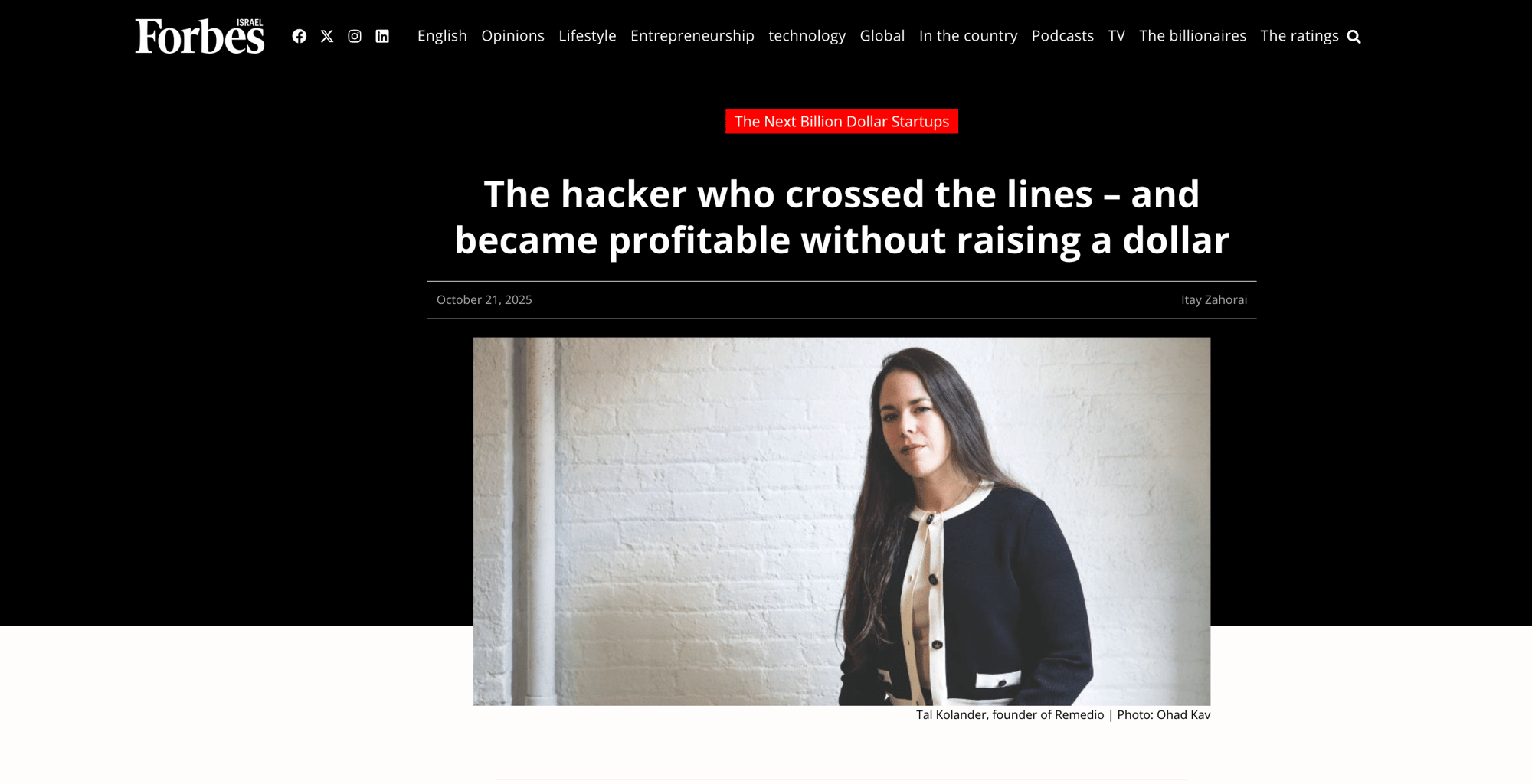
Rare, but that is the story of Israeli cybersecurity startup Remedio (formerly GYTPOL), founded by former hacker and current entrepreneur Tal Kollender, who serves as the company’s co-founder and CEO – itself an uncommon sight in the technology industry generally and cybersecurity in particular.
“A third of our company is women, mainly in management positions,” the CEO says proudly when asked about her experience as a woman working in an industry still overwhelmingly dominated by men. “I remember that early on, at conferences, people assumed I was a salesperson,” she recalls with half a smile, “until they heard me speak and realized how technical I am.”
The cybersecurity startup she has led since its founding developed a platform for real-time detection, remediation and prevention of misconfigurations on enterprise endpoints. Last September, it announced its first funding round of $65 million – a significant milestone in the company’s growth trajectory and, in practice, the end of its profitable, independent period as a successful bootstrap and the beginning of its global growth journey.
The Series A round, led by U.S. venture capital firm Bessemer Venture Partners with participation from TLV Partners and Picture Capital, valued the company at $300 million. Yet even that demanding valuation does not faze the ambitious entrepreneur, who appears to have both hands firmly on the wheel.
“I was told that our ARR (annual recurring revenue) and the investment in us are equivalent to those of a company at a Series C,” she says enthusiastically, then quickly balances that with a sober perspective. “I’m strong, and I’m a bulldozer with a clear goal in front of me, and still this entire journey to get here was not simple at all,” she admits. “A real roller coaster. Very hard work that started truly from zero. It took years to build a winning team and develop the company into what we see today.”
Automated Remediation
Remedio, founded in 2019, has been profitable since its inception, according to its executives, and until very recently operated as a bootstrap without any external investment. The large investment it has just raised is intended to fuel continued accelerated growth, expansion into additional markets, a stronger U.S. presence and development of the next generation of autonomous security management solutions.
Remediation, as the cliché goes, starts from within. Alongside the funding announcement, the company, previously known as GYTPOL, unveiled its new name – Remedio – intended to reflect the essence of the product on which the company was founded: “fixing, treating or removing a problem.” In the context of cybersecurity, the name corresponds with the product – taking action to remediate a discovered vulnerability by updating software, changing security settings, blocking access or deploying a patch.
This is also the technological innovation at the company’s core. Remedio developed a platform that provides control over security configurations on enterprise endpoints, identifies deficiencies and remediates them in real time – without requiring manual intervention. Unlike traditional security tools that stop at alerts, Remedio’s platform also performs the remediation itself autonomously, using an AI engine that executes immediate fixes together with full rollback capability.
In doing so, the technology addresses one of security’s most pressing problems: endpoint configuration failures created by users themselves that open critical security gaps. The platform identifies such failures across operating systems and devices, alerts on them and remediates them immediately. In this way, it helps keep systems secure, compliant and resistant to compromise – without disrupting ongoing operations.
“It’s Time to Expand”
Kollender, who has served as CEO since the company was founded, says she spent much of her youth as a “hacker” – described by the Israel National Cyber Directorate’s cyber terminology dictionary as “a person with extensive knowledge of communications and computing systems who can use it to break into such systems, take control of them and perform various actions within them.”
“Countless friends whose computers had been hacked asked me for help. It was really fun,” she recalls. She also speaks, half-confidentially, about “hacking challenges” involving “all kinds of places.” “Later I built defensive products to respond to attacks. I was both the attacker and the defender, and I sold security products.
“Back then, it wasn’t as simple as it is today,” Kollender notes. “There was no Google, there was no ChatGPT to teach you all kinds of tricks. You had to write all the code yourself.”
She began her military service in flight school and, after a short stint there (“the pilot next to me didn’t appreciate that I thought I was better than him,” she says sarcastically), was assigned to the IDF’s Mamram computing unit. After her discharge, she translated the experience she gained in the military into various security roles in the business world. Her last position before becoming an entrepreneur was Chief Information Security Officer (CISO) at technology giant Dell EMC.
In 2019, Kollender joined forces with two experienced entrepreneurs with a proven track record and an impressive exit behind them, and together they founded Remedio. Both continue to manage the company alongside her: Gilad Raz, the company’s VP Technology, founded IT startup Digital Fuel, which was acquired in 2011 by cloud computing giant VMware. Yakov Kogan, a former academic researcher and Raz’s business partner at Digital Fuel, now serves as VP Engineering.
Today, the company founded by the three entrepreneurs employs about 40 people in Israel, the United States and Europe – a team that is naturally expected to expand following the significant funding round. CEO Kollender’s objective is clear: “We built a profitable, growing business without raising a dollar. Now, after earning the trust of some of the world’s largest companies, it is time to expand and realize the product’s full potential.”
“We have eight-figure ARR and a $300 million valuation,” she says in a special interview with Forbes Israel – numbers that seem almost unimaginable for what, until recently, was a bootstrap that had not raised a shekel. “Our entire journey is unusual. Everyone who hears about us has trouble understanding it,” Kollender says enthusiastically. “Today, in this world, there is no such thing as a profitable cybersecurity startup, certainly not a startup with 40 people already generating revenue from Fortune 500 customers.”
“We have been profitable from day one. We grew nicely. But the more I studied the question of how to build a successful business, the more I understood that to elevate yourself, you have to take money, you have to accept investment. Otherwise, you won’t be able to grow the right way.”
Why now? An unwritten rule in the industry says you raise money when you can, not when you need to. And you could have raised at any point over the past few years.
“There are two reasons. The first is that the current product sells well and continues to sell well, and we still need to ‘scale it up.’ That is the first objective, but it is not the objective.
“The real objective is that we are going to develop a product with a feature that will compete head-to-head across the domains of the major players in the market, such as Rapid7, Qualys and Tenable, in vulnerability management. The difference is that we add the management aspect. While the other companies show you what is wrong, we also fix it. Every module in our system is not ‘let’s investigate the problem,’ but ‘let’s solve the problem.’ So we are going to change this entire space, expand significantly in the United States, with an emphasis on marketing and sales there – and that requires money. How much money? Let’s start with what we have now.”
Still, don’t you regret not raising a few years earlier? Perhaps your revenue would be several times higher today.
“Our ambition today is to reach $100 million in ARR very, very quickly. To do that, there is still a great deal of work to do. Think about it: until two weeks ago, I didn’t even have a VC guiding me. We built everything with our own ten fingers. It takes time. And for that, you need the very best people. If I didn’t have the people I have on the team today, I wouldn’t have gone out to raise at all because I wouldn’t have understood our potential. It is all thanks to the people, and our team is our strength. What we built here – the people I chose to have with me on this journey, who then brought in their own people – it’s an incredible operation.”
So what is your secret? Where is your advantage over the other products in the market?
“Today, our major customers include giants such as Amazon and Colgate. Colgate has been a customer for several years, and Amazon joined recently. They have already seen everything in this field, and still they chose us. Amazon already calls us ‘The Wiz of devices.’ They are very excited by the fact that despite having many internal tools, even when all of them are combined, they still cannot deliver what we deliver or do what we do – and certainly neither can other products in the industry.”
What is your next goal? What is the End Game – an acquisition like WIZ or an IPO like WIX?
Assaf (Rappaport, Wiz) is a role model – but on the other hand, so is George Kurtz (founder and CEO of cybersecurity giant CrowdStrike, which trades on Nasdaq at a valuation of around $120 billion). George is an extremely smart person. Look at what happened in July 2024 (a faulty update that caused one of the largest IT outages in history – I.Z.) and look at the stock now – at an all-time high. It is crazy. He is simply a genius, and from my perspective he is a role model.”
So an IPO is more aligned with your vision.
“And that also seems very realistic to me. I’m not there yet – but that is definitely where I’m aiming.”